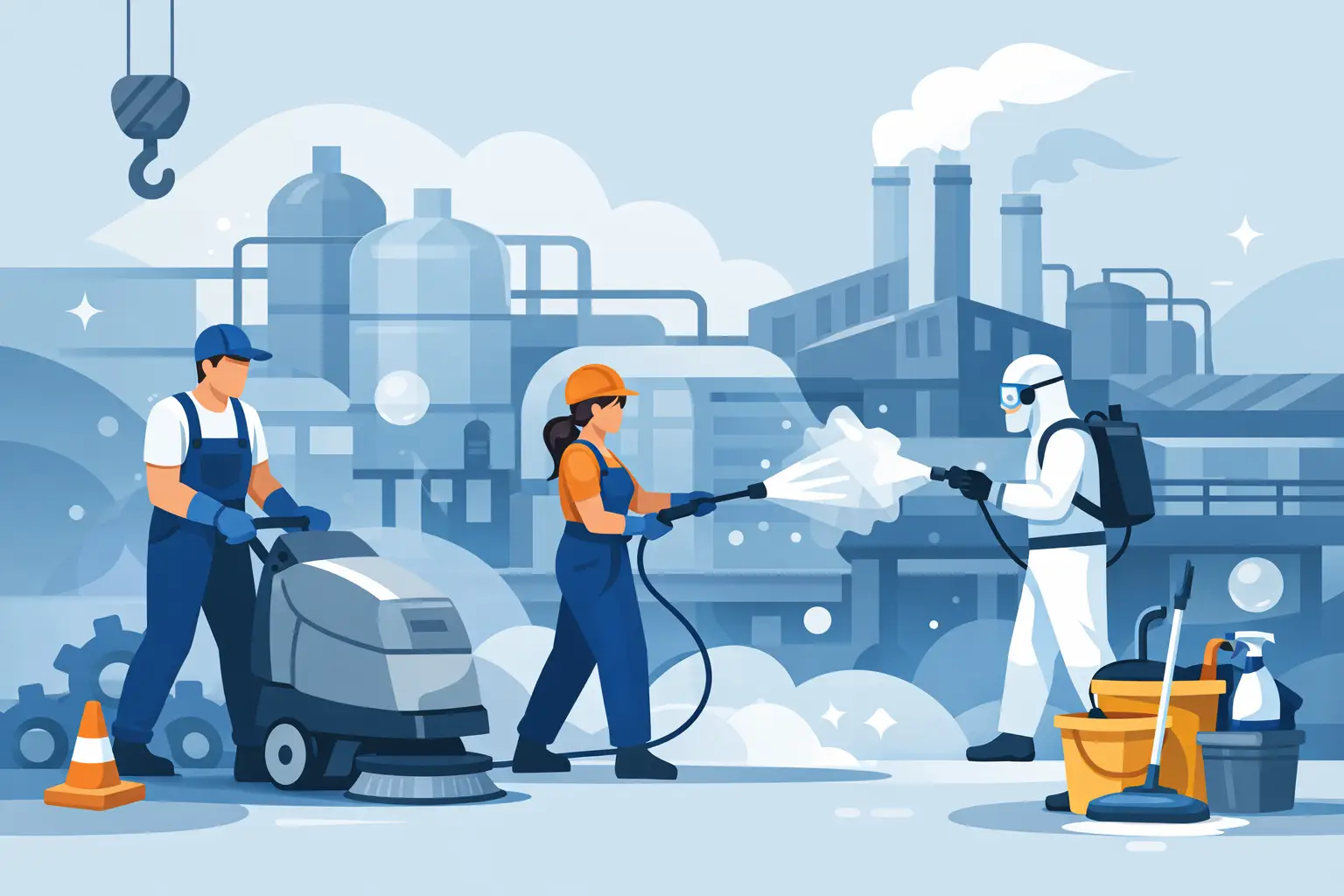
A warehouse floor coated with dust, oil, and pallet debris needs a different level of care than a front office lobby. The same goes for food production spaces, manufacturing lines, loading docks, and utility areas. If you are asking what is industrial cleaning services, the short answer is this: it is specialized cleaning designed for industrial environments where safety, compliance, uptime, and heavy-use conditions matter as much as appearance.
Industrial cleaning goes beyond standard janitorial work. It focuses on facilities with machinery, production activity, storage demands, higher-risk materials, and more complex operational requirements. In many cases, the work must be performed around shifts, during shutdown windows, or in restricted areas where cleaning crews need the right training, processes, and equipment.
What Is Industrial Cleaning Services in Practical Terms?
Industrial cleaning services are professional cleaning solutions tailored to factories, warehouses, plants, distribution centers, and other operational facilities. The goal is not simply to make a space look clean. It is to support a safer work environment, reduce buildup that can affect equipment or workflow, and help the facility maintain consistent standards over time.
That distinction matters. A typical office cleaning program may center on restrooms, breakrooms, trash removal, floors, and touchpoint disinfection. Industrial cleaning often includes those tasks in administrative areas, but it also addresses heavier-duty needs such as degreasing, dust control, floor scrubbing in production zones, high-surface cleaning, spill response, and cleaning around equipment or storage systems.
For many businesses, the right service plan combines both. A single property may have office suites up front, warehouse operations in the rear, and employee support spaces in between. That is why a one-size-fits-all cleaning schedule usually falls short.
Where Industrial Cleaning Services Are Commonly Used
Industrial cleaning is typically used in facilities where operations create more residue, risk, or wear than a standard commercial setting. Manufacturing plants are one of the clearest examples because production naturally creates dust, scraps, grease, and particulate buildup. Warehouses and distribution centers also rely on industrial cleaning to control debris, maintain floor conditions, and keep traffic lanes clear and presentable.
Other common environments include logistics hubs, food processing areas, utility spaces, machine shops, storage facilities, transportation yards, and large maintenance buildings. Even mixed-use commercial sites may need industrial-level support in back-of-house areas where forklifts, inventory movement, packing materials, and heavy foot traffic create ongoing cleaning demands.
In the Chicagoland market, this is especially relevant for businesses operating long hours, managing seasonal volume spikes, or balancing office presentation with active facility use. Cleaning has to work around operations, not interrupt them.
What Industrial Cleaning Usually Includes
The scope depends on the facility, but industrial cleaning services often include floor scrubbing, degreasing, debris removal, dust control, restroom sanitation, breakroom cleaning, trash and recycling management, and cleaning of high-touch and high-traffic surfaces. Some programs also involve high dusting, wall cleaning, dock area cleaning, and specialty work around production or storage zones.
A stronger provider will start by separating tasks by area and risk level. Administrative offices may need routine janitorial care. Warehouse aisles may need machine scrubbing and spot treatment. Production support areas may require more frequent cleaning because buildup affects safety and efficiency. Exterior-facing entry points may need additional attention to maintain a professional appearance for staff, vendors, and visitors.
Frequency can vary widely. Some sites need daily service, while others need a mix of nightly cleaning, weekly deeper maintenance, and periodic specialty work. The best plan reflects actual facility usage instead of a generic checklist.
How Industrial Cleaning Differs From Standard Commercial Cleaning
This is where confusion often happens. Commercial cleaning is a broad term that includes offices, retail stores, schools, medical offices, and other business environments. Industrial cleaning is a subset of commercial cleaning, but it is built for tougher conditions and more operational complexity.
The difference shows up in the work itself. Industrial spaces usually require stronger equipment, more detailed safety protocols, and more flexibility around service hours. Crews may need to clean larger floor areas, work near equipment, manage material-specific residue, or coordinate with site rules related to access, lockout procedures, or traffic control.
It also shows up in planning. In a standard office, cleaning often happens after business hours with a consistent checklist. In an industrial facility, service may need to change by shift, season, production schedule, or occupancy level. That is why experienced providers focus on customization and reliability, not just task completion.
Why Businesses Invest in Industrial Cleaning Services
For most facility leaders, the decision comes down to risk, presentation, and efficiency. Dirty floors, dust accumulation, neglected restrooms, and unmanaged debris can affect safety, employee morale, and first impressions all at once. In active environments, minor cleaning issues can become larger operational problems if they are ignored.
Regular industrial cleaning helps reduce slip hazards, control dust, improve sanitation, and create a more organized environment for employees and visitors. It can also support internal standards and inspections, especially in facilities where cleanliness affects workflow, product handling, or compliance expectations.
There is also a staffing reality. Many businesses do not want to pull internal teams away from operations to handle specialized cleaning tasks. Outsourcing to a dependable commercial partner creates accountability and consistency, especially when service has to happen after hours, overnight, or on weekends.
What to Look for in an Industrial Cleaning Provider
A strong provider should understand that industrial cleaning is operational support, not just custodial labor. That means building a service plan around the way your facility actually runs. If your warehouse has overnight shifts, the cleaning schedule should reflect that. If certain production areas can only be accessed during narrow windows, the provider should be able to work within them.
Reliability is usually the first factor decision-makers care about, and for good reason. Missed service in an industrial setting is rarely a small issue. It can affect safety, appearance, inspections, and staff confidence in a matter of days. Responsiveness matters just as much, especially when spills, weather, traffic, or production changes create unexpected needs.
It is also worth asking how the provider handles quality control. Consistency is harder to maintain in larger, more demanding environments. Clear scopes of work, site-specific checklists, regular communication, and supervisory oversight make a noticeable difference.
For companies that need both office-facing polish and industrial-level support, a customized maintenance plan is often the best fit. That is where a partner such as Americlean Professional Services can bring value by aligning service levels with facility use, schedule demands, and presentation standards.
When a Customized Plan Makes More Sense Than a Standard Package
Industrial facilities rarely operate on perfect routines. Volume changes. Staffing changes. Weather affects entries and dock areas. Some parts of the building stay relatively clean, while others need constant attention. That is why fixed packages can create either gaps in service or unnecessary spending.
A customized plan allows businesses to set priorities by area, frequency, and operational impact. For example, a property manager may need daytime porter support in shared spaces, evening janitorial service in office areas, and scheduled floor care in warehouse zones. A manufacturing site may need heavier cleaning around specific processes but lighter maintenance elsewhere.
The right approach depends on the facility. More service is not always better. Better-targeted service usually is.
Common Misunderstandings About Industrial Cleaning
One common misconception is that industrial cleaning only applies to large factories. In reality, many mid-sized commercial properties have industrial cleaning needs in certain zones, especially where storage, shipping, packaging, equipment use, or high-volume traffic are involved.
Another misconception is that any janitorial vendor can handle industrial environments with the same methods used in offices. Sometimes that works for light-duty areas, but not always for the full facility. Industrial spaces often demand more planning, stronger equipment, and better coordination with site operations.
There is also the assumption that industrial cleaning is only about compliance. Compliance may be part of the picture, but most businesses also care about uptime, employee experience, and the impression their facility makes on customers, partners, and staff.
A Better Way to Think About Industrial Cleaning Services
Instead of thinking of industrial cleaning as a separate category of cleaning, it helps to think of it as a higher-demand service model for higher-demand environments. The question is not only whether a space gets cleaned. The question is whether it gets cleaned in the right way, at the right time, and to a standard that supports the business using it.
That is usually the difference between a vendor that shows up and a service partner that actually helps your facility run better.
If your building includes production space, warehouse activity, back-of-house operations, or heavy-use service areas, industrial cleaning should be treated as part of facility performance, not an afterthought. The cleaner your environment is, the easier it becomes to protect safety, support your team, and keep the business moving without unnecessary disruption.