A clean lobby at 8:00 a.m. looks simple. What happens behind that result usually is not. If you are evaluating vendors and asking what do commercial cleaning services offer, the real answer goes well beyond emptying trash and running a vacuum. For most businesses, commercial cleaning is a mix of routine janitorial work, scheduled deep cleaning, site-specific maintenance, and service planning built around your hours, traffic, and standards.
That matters because every facility runs differently. An office with steady weekday occupancy has different needs than a medical building, a retail space, a school, or a multi-tenant property. The best commercial cleaning providers do not force those environments into the same package. They build a service scope that supports operations without creating disruption.
What Do Commercial Cleaning Services Offer in Practice?
At a practical level, commercial cleaning services typically cover the day-to-day tasks that keep a property clean, presentable, and safe for employees, visitors, and tenants. That usually includes cleaning restrooms, breakrooms, common areas, entrances, workspaces, floors, and high-touch surfaces. It may also include restocking consumables, managing interior trash and recycling, and addressing areas that show wear quickly because of heavy foot traffic.
The key difference between commercial cleaning and casual cleaning support is consistency. Businesses are not just hiring for a one-time visual improvement. They are hiring for repeatable results, accountability, and a schedule that matches how the building is actually used.
A quality provider will usually start by defining scope clearly. That means identifying what gets cleaned daily, weekly, monthly, or on an as-needed basis. It also means clarifying who is responsible for specialty tasks, after-hours access, emergency response, and quality control.
Routine Janitorial Services
For many organizations, the foundation of a cleaning contract is routine janitorial service. This is the recurring work that keeps the facility operational and ready for daily use.
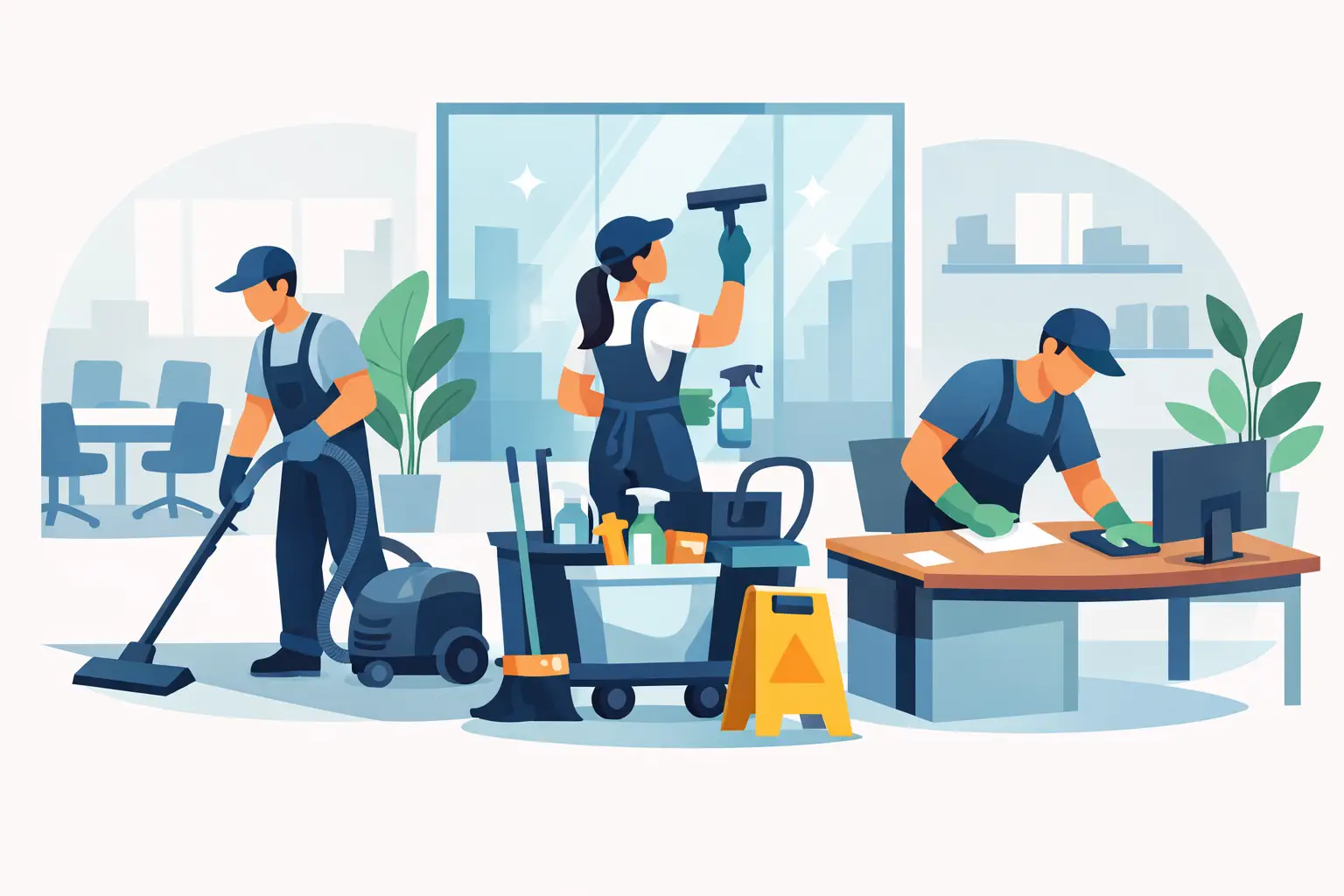
In an office or commercial property, that often includes trash removal, dusting reachable surfaces, vacuuming carpet, mopping hard floors, wiping desks or shared workstations as requested, cleaning glass entry doors, and sanitizing restrooms. Breakrooms may require countertop cleaning, sink sanitation, floor care, and attention to appliance exteriors.
Routine janitorial support is where reliability matters most. Missed restroom service, overflowing trash, or neglected entrances are noticed immediately. For property managers and facility leaders, these are not minor cosmetic issues. They affect tenant satisfaction, employee experience, and the professionalism of the space.
The frequency depends on the building. Some sites need daily service, others need several visits per week, and high-traffic environments may need daytime porter support in addition to evening cleaning. The right schedule depends on occupancy, business hours, and how quickly visible wear builds up.
Floor Care and Surface Maintenance
Floors carry a large share of the visual burden in any commercial space. Even when the rest of a facility is reasonably clean, neglected floors can make the entire environment feel poorly maintained.
Commercial cleaning services often include carpet vacuuming as part of routine care, but floor maintenance usually goes further than that. Hard floors may need scrubbing, buffing, burnishing, or periodic stripping and refinishing. Carpets may need scheduled extraction or spot treatment. Tile and grout may require deeper restoration depending on use and soil buildup.
This is one of the clearest examples of why one-size-fits-all pricing can be misleading. A low-traffic office suite and a busy healthcare waiting area do not put the same demands on flooring. The materials also matter. Luxury vinyl tile, concrete, ceramic tile, and broadloom carpet all require different care methods and different frequencies.
A strong provider will account for those variables instead of applying the same routine everywhere.
Restroom Sanitation and Supply Support
Restrooms tend to be one of the biggest decision points in vendor satisfaction. They are high-visibility spaces, they affect health and perception, and they create complaints quickly when standards slip.
Commercial cleaning services usually include cleaning and disinfecting toilets, urinals, sinks, mirrors, partitions, counters, and floors. Touchpoints such as dispensers, handles, and switches should also be addressed regularly. In many cases, vendors can also restock paper products, soap, and other consumables if that is part of the agreement.
The important distinction is that restroom service should be based on actual usage, not assumptions. A restroom used by a small office team may only need standard nightly attention. A restroom in a public-facing facility may need multiple service checks throughout the day. Service planning should reflect that reality.
High-Touch Disinfection and Health-Focused Cleaning
Many businesses now expect more attention to hygiene-sensitive areas than they did a few years ago. That does not mean every site needs medical-grade protocols, but it does mean high-touch disinfection is often part of a modern commercial cleaning plan.
This may include door handles, elevator buttons, reception counters, shared kitchen surfaces, conference tables, handrails, light switches, and other contact points. In some environments, it may also include more structured disinfection procedures for shared equipment or regulated spaces.
There is a trade-off here. More frequent touchpoint cleaning improves sanitation, but it also increases labor and service cost. That is why a good vendor helps businesses decide where enhanced disinfection is necessary and where standard routine cleaning is sufficient.
Specialty and Periodic Cleaning Services
Not everything should be handled on a nightly checklist. Commercial cleaning services often offer periodic work that supports the long-term condition of the facility.
This can include interior window cleaning, detailed dusting of vents and high surfaces, upholstery cleaning, carpet extraction, tile and grout cleaning, post-construction cleanup, and deep cleaning for seasonal resets or special events. Some providers also handle emergency cleanup support, which can be critical for facilities that cannot afford extended disruption.
Periodic service is often what separates a facility that stays consistently sharp from one that slowly declines between daily cleanings. Routine janitorial work maintains the space. Periodic specialty work restores it.
Customized Service Plans and Scheduling
One of the most valuable things a commercial cleaning company can offer is not a task. It is a plan.
Businesses operate on different schedules, and cleaning should work around that. Some facilities need after-hours service to avoid interrupting staff and customers. Others need early morning touch-ups before opening. Some require weekend support, while others need flexibility for seasonal traffic changes or tenant turnover.
For Chicagoland businesses managing varied occupancy patterns, this is often where the right partner stands out. A dependable company should be able to scale service frequency, adjust scope, and respond when facility demands change. Americlean Professional Services is built around that kind of customized, around-the-clock support, which is especially valuable for organizations that cannot rely on a fixed, generic cleaning schedule.
What Is Sometimes Included - and Sometimes Not
One common issue in commercial cleaning contracts is assumption. A business may think a service is included because it seems obvious, while the vendor may treat it as extra work.
That is why scope clarity matters. For example, interior window glass may be included, but exterior window cleaning may not be. Day porter service may be separate from evening janitorial service. Consumable restocking may be included, while product purchasing is billed separately. Deep floor restoration, warehouse cleaning, high dusting, or post-event cleanup may also fall outside the base contract.
This is not necessarily a problem. It just needs to be discussed upfront. A reliable cleaning provider should explain what is standard, what is periodic, and what requires a custom quote.
What Businesses Should Really Look For
If you are comparing providers, the better question may not be only what do commercial cleaning services offer. It may be how well they deliver those services over time.
A strong commercial cleaning company should offer clear communication, dependable staffing, quality checks, responsive issue resolution, and a service plan that reflects your actual facility needs. Price matters, but consistency matters more. The cheapest contract can become expensive fast if it leads to complaints, missed tasks, or constant vendor management.
The right fit usually comes from alignment. Your building type, operating hours, compliance expectations, and appearance standards should shape the cleaning program. If a company cannot explain how it will tailor service to those conditions, it may not be the right long-term partner.
Cleanliness in a commercial setting is not just about appearance. It supports safety, employee confidence, visitor impressions, and the day-to-day rhythm of the business. The best cleaning services offer more than labor. They offer structure, dependability, and the ability to keep your facility ready for whatever the day brings.
When a cleaning partner understands that, the difference shows up everywhere people notice first.