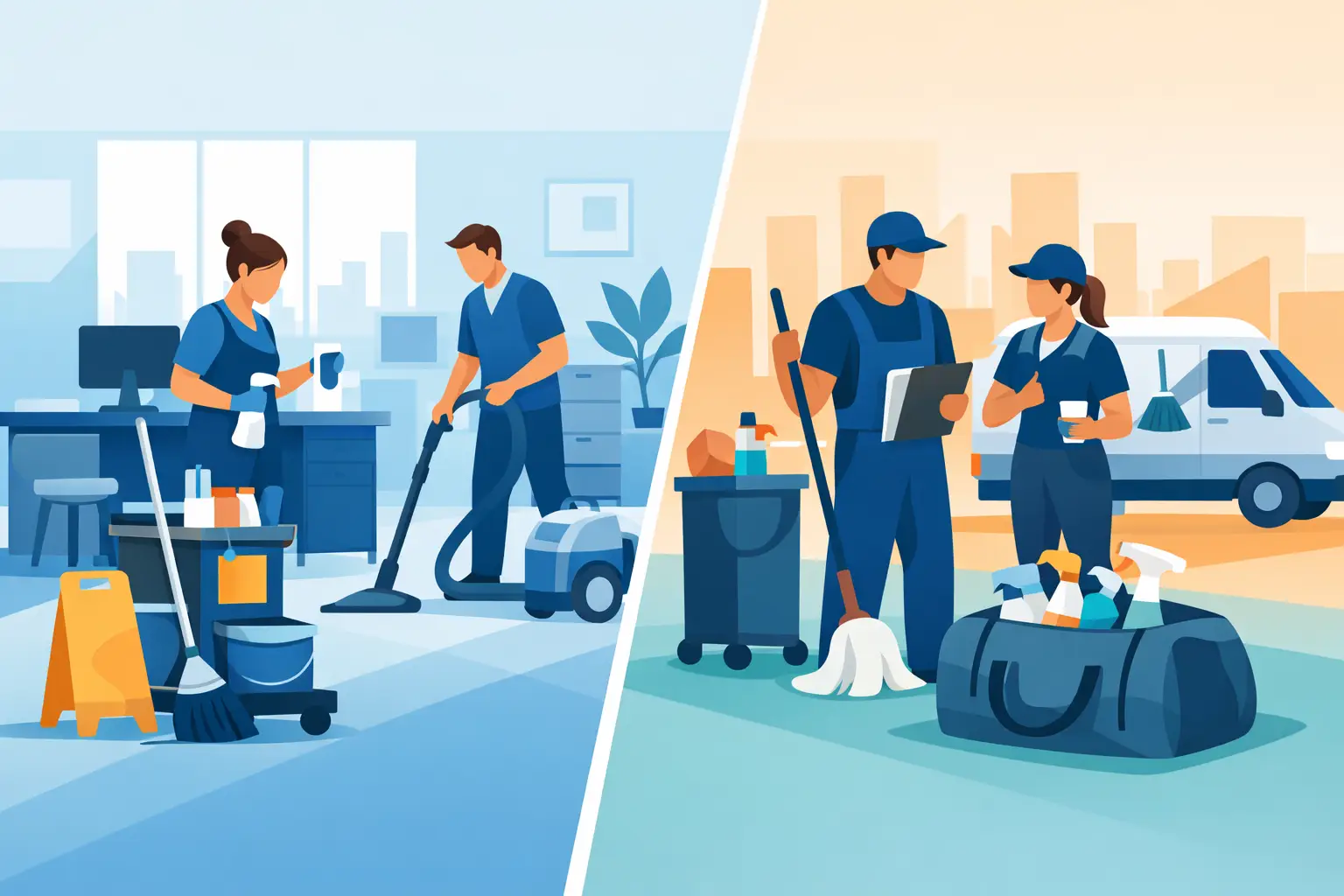
When a facility starts missing the mark on cleanliness, the problem usually shows up fast. Restrooms get inconsistent attention, high-touch areas are overlooked, complaints increase, and managers end up spending time on cleaning issues instead of operations. That is usually when the question becomes urgent: in house vs contract cleaning - which model actually gives your business better control, better consistency, and better value?
For commercial properties, offices, medical-adjacent spaces, retail sites, and multi-tenant buildings, the right answer depends less on preference and more on operational fit. Staffing demands, after-hours access, compliance expectations, turnover, budget structure, and accountability all shape the decision. A cleaning model that works for one facility may create unnecessary strain for another.
In house vs contract cleaning: what is the difference?
In-house cleaning means your company hires and manages cleaning staff directly. Those team members are part of your internal operation, whether they clean full time, part time, or as part of a broader facilities department. Your business handles hiring, payroll, training, supervision, scheduling, performance management, and supply purchasing.
Contract cleaning means you work with an outside commercial cleaning provider under a service agreement. The cleaning company supplies labor, supervision, training, equipment, and often the consumables or specialty tools needed to maintain the space. The scope is usually tailored around your building, schedule, and service priorities.
At a surface level, the distinction sounds simple. In practice, the difference comes down to who owns the operational burden. That matters more than many businesses expect.
Where in-house cleaning can make sense
There are cases where in-house staffing is a reasonable fit. If your facility is small, your cleaning needs are basic, and you already have internal management capacity, hiring directly can seem more straightforward. Some organizations also prefer having cleaners on payroll because they feel it gives them more immediate oversight.
An in-house model can work well when cleaning tasks are predictable and limited in scope. If your building runs on stable hours, has low public traffic, and does not require specialized floor care, disinfection protocols, or flexible after-hours support, internal staffing may be manageable.
There can also be cultural advantages. Long-term internal staff may become familiar with the facility, the occupants, and the standards leadership expects. For some businesses, that familiarity creates a strong sense of ownership.
Still, those benefits come with real responsibilities. Direct control sounds appealing until a cleaner calls off, supplies run short, or training falls behind. At that point, control also means direct exposure to every staffing and service gap.
The real challenges of in-house cleaning
The biggest issue with in-house cleaning is not usually the cleaning itself. It is the management load behind it. Commercial cleaning is a system, not just a labor function. Hiring one or two staff members does not automatically create quality assurance, cross-coverage, documented procedures, or reliable service continuity.
Turnover is often the first pressure point. If an employee leaves, your team has to recruit, onboard, and train a replacement. If someone is absent, coverage may be limited. In many businesses, that means office managers, operations leaders, or maintenance supervisors are pulled into a role they were never hired to manage.
Cost can also be misunderstood. Internal staffing may look less expensive on an hourly basis, but labor is only one line item. Payroll taxes, benefits, workers' compensation, equipment, supply storage, training time, supervision, and replacement coverage all affect the true cost. If you need evening or overnight cleaning, labor costs may climb further.
Consistency is another challenge. Unless your business has a strong internal facilities structure, quality control can vary from shift to shift and person to person. Cleaning standards tend to slip when no formal inspection process is in place, especially in larger or higher-traffic buildings.
Why many facilities choose contract cleaning
Contract cleaning is often the stronger option for businesses that need dependable results without adding internal administrative burden. A qualified commercial cleaning partner brings a full operating model, not just labor. That includes trained staff, supervisory oversight, equipment readiness, scheduling systems, and accountability tied to a service agreement.
For facility managers and business owners, that shift matters. Instead of managing individual cleaners, you manage outcomes. The conversation moves from who called off to whether the building is being maintained to standard.
This model becomes especially valuable in facilities with variable usage, tenant needs, public traffic, or extended operating hours. A contract provider can scale service frequency, add specialty support, and adjust scheduling around your business rather than forcing your internal team to absorb every change.
Professional contract cleaning also tends to support stronger consistency. Established providers use checklists, site-specific scopes, supervision, and recurring quality reviews to reduce variation. That structure is one reason many commercial clients see fewer complaints and better day-to-day presentation after outsourcing.
Cost is not just about the hourly rate
When businesses compare in house vs contract cleaning, cost is often the first factor on the table. That makes sense, but hourly labor alone is not the right comparison.
With in-house staffing, your direct wage is only part of the picture. You still carry recruiting costs, HR time, payroll administration, insurance exposure, equipment purchases, supply ordering, training, and productivity loss when coverage fails. If your internal team is small, one absence can affect the whole building.
With contract cleaning, pricing is usually more predictable. You pay for an agreed scope of work and service frequency, not for every internal task required to keep the operation functioning. The value is not simply lower labor cost. It is reduced management burden, more reliable execution, and fewer service interruptions.
That said, contract cleaning is not automatically cheaper in every case. A very small office with light needs may decide direct hiring is workable. But as soon as complexity increases, the outsourced model often becomes more efficient because it distributes staffing, supervision, and operational risk across a professional provider.
Control versus accountability
Some businesses hesitate to outsource because they worry about losing control. That concern is understandable, especially if they have had inconsistent vendor experiences in the past.
But there is an important distinction between control and accountability. In-house teams give you direct authority over employees, but they also make you responsible for solving every staffing, training, and quality issue internally. Contract cleaning shifts that responsibility to a provider, which can improve accountability if the service partner is responsive and well managed.
The key is structure. A vague cleaning agreement will create frustration. A detailed scope, clear communication channels, documented expectations, and responsive supervision create measurable performance. In many cases, that gives a client more practical control over results, not less.
For businesses operating in Chicagoland, this matters even more. Weather, foot traffic, seasonal salt, lobby presentation, and variable occupancy can all affect how a building needs to be maintained. A one-size-fits-all service plan rarely holds up under those conditions.
When contract cleaning is usually the better fit
Contract cleaning tends to make the most sense when your facility needs after-hours service, multiple cleaning frequencies, specialized floor or restroom care, or dependable coverage across a larger footprint. It is also the stronger model when your internal team is already stretched and cannot afford to absorb janitorial management on top of other responsibilities.
Organizations with client-facing space often benefit as well. Cleanliness is not just a maintenance issue in those environments. It affects brand perception, employee experience, and how professionally the business operates day to day.
A strong provider can also adapt as your needs change. If occupancy rises, a tenant mix changes, or seasonal conditions create new cleaning demands, the service plan can be adjusted without forcing you to rebuild staffing internally. That flexibility is one of the biggest operational advantages of outsourcing.
For many commercial clients, the best arrangement is not generic contract cleaning. It is a tailored service plan built around the facility's schedule, traffic patterns, and standards. That is where an experienced provider adds the most value. Companies like Americlean Professional Services are often brought in for exactly that reason - not just to clean, but to deliver dependable support that fits how the property actually operates.
How to make the right choice for your facility
The best decision starts with an honest review of what your building requires every week, not what seems easiest on paper. Look at how many hours are spent managing cleaning issues, how often standards slip, whether coverage is dependable, and how much flexibility your operation needs.
If your space is simple, your staffing is stable, and your internal team has time to manage quality closely, in-house cleaning may be workable. If your facility needs consistency, backup coverage, flexible scheduling, and a partner who can maintain standards without constant oversight, contract cleaning is usually the better business decision.
Clean buildings do not stay clean by accident. They stay clean when the service model matches the demands of the facility. The right choice is the one that protects your time, supports your standards, and keeps your operation running without distraction.