A lobby can look fine at first glance and still tell a different story by noon. Smudged glass, overflowing restroom trash, dusty vents, and sticky breakroom floors usually do not appear all at once. They show up as patterns. That is why knowing how to evaluate cleaning quality matters for any business that depends on a clean, safe, and professional environment.
For property managers, office administrators, and facility leaders, cleaning quality is not just about appearance. It affects employee confidence, visitor impressions, health expectations, and day-to-day operations. The challenge is that many issues are easy to miss until complaints start coming in. A better approach is to evaluate cleaning with clear standards, consistent checks, and realistic expectations tied to how your facility actually functions.
How to evaluate cleaning quality in a commercial facility
The most reliable way to assess cleaning quality is to move beyond general impressions. "Looks clean" is too subjective to manage performance over time. One supervisor may accept a freshly vacuumed carpet with visible edge dust, while another will flag it as incomplete. If your expectations are not defined, your results will vary.
Start by separating your evaluation into three practical categories: visual presentation, hygienic condition, and service consistency. Visual presentation covers what people notice right away, such as streak-free surfaces, orderly common areas, clean floors, and properly stocked restrooms. Hygienic condition focuses on whether touchpoints, restrooms, kitchens, and shared equipment are being cleaned to the standard your facility requires. Service consistency measures whether those outcomes happen on schedule, across shifts, and without constant follow-up.
A medical office, a corporate suite, and an industrial site will not use the same checklist. That is where many cleaning relationships break down. The quality standard has to match the environment, traffic level, and business hours. A facility with heavy public traffic may need multiple restroom checks per day. A professional office with client visits may place more emphasis on entryways, conference rooms, and glass. Evaluation only works when it reflects operational reality.
Build standards before you start scoring performance
If you want meaningful inspections, define what "clean" means area by area. Entrances should be free of debris, glass should be free of fingerprints, floors should be free of visible soil, and trash should be removed before containers reach capacity. In restrooms, dispensers should be stocked, fixtures should be sanitized, mirrors should be clean, and odors should be addressed rather than masked.
The more specific the standard, the easier it is to measure performance fairly. Vague expectations create tension on both sides. Your team may feel the service is slipping, while the vendor may believe the work is complete because there is no shared definition of success.
This is also where timing matters. A restroom inspected at 8:00 a.m. may pass easily and fail by 2:00 p.m. in a high-traffic building. That does not always mean the cleaning team did poor work. It may mean the frequency is wrong for the occupancy level. When evaluating quality, separate cleaning execution from service plan design. Sometimes the issue is not quality but insufficient coverage.
Use zone-based inspections
A full-building inspection can become too broad to be useful. It is often better to divide the facility into zones such as lobby, restrooms, workstations, conference rooms, breakrooms, and high-touch common areas. Evaluate each zone against the standard that applies to that space.
This method helps you see patterns faster. If breakrooms consistently fall short but offices remain in excellent condition, the problem may be scheduling, staffing, or scope allocation rather than a general service failure. Zone-based inspections also make follow-up more precise, which saves time for both your internal team and your cleaning partner.
Focus on high-impact details
Not every cleaning flaw carries the same weight. A missed corner in a storage area does not affect your business the way a poorly maintained restroom or dirty front entrance does. Evaluate with priorities in mind.
The most important areas usually include entrances, reception spaces, restrooms, shared kitchens, floors in high-traffic corridors, and high-touch surfaces such as door handles, elevator buttons, and conference tables. These spaces shape first impressions and influence how people judge the entire building.
Measure consistency, not one-time effort
One strong cleaning visit can hide an inconsistent operation. That is why a single walkthrough rarely tells the full story. If you want to know whether your cleaning program is working, review performance over time.
Look for recurring issues such as supply shortages, missed trash removal, visible dust on horizontal surfaces, or floors that lose appearance too quickly after service. Repetition matters. When the same issue appears week after week, it points to a breakdown in process, staffing, supervision, or scope alignment.
Consistency also includes communication. If problems are reported and corrected quickly, that is a sign of a responsive service partner. If issues linger, get repeated, or require escalation every time, the cleaning quality problem may be operational rather than technical.
How to evaluate cleaning quality with inspections and feedback
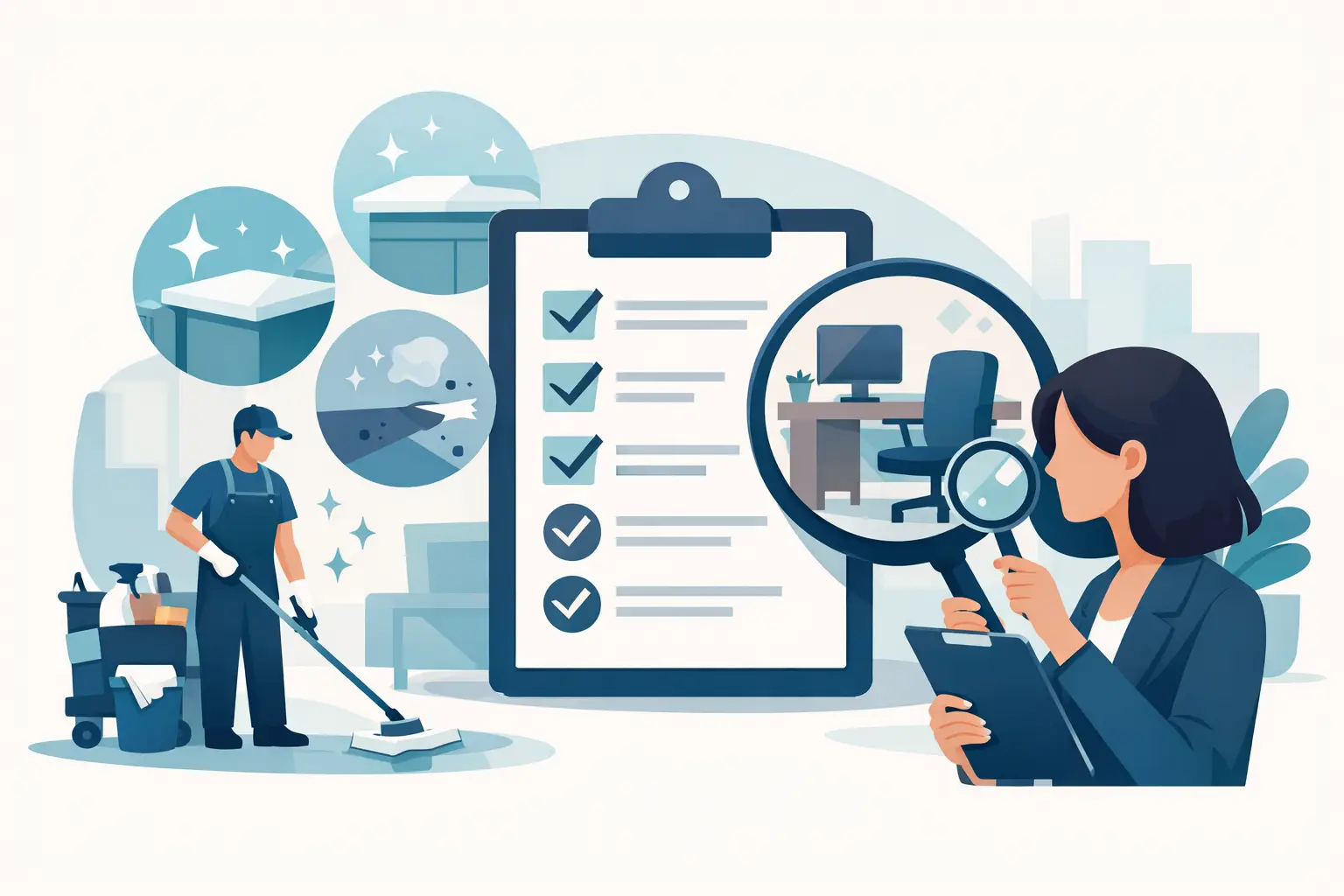
The best evaluation process combines formal inspections with real-world feedback from the people using the space. A checklist is useful, but it should not be the only source of truth. Occupants notice recurring problems that may not appear during a scheduled walkthrough.
Set a regular inspection rhythm that fits your building. For some facilities, weekly spot checks are enough. For others, especially larger or high-traffic properties, more frequent inspections may be appropriate. What matters is that the process is predictable and documented.
During inspections, keep scoring simple. You do not need a complicated rating system. Pass or needs attention can work well if your standards are clearly written. If you prefer a numeric score, tie it to specific conditions rather than general impressions. A score is only useful if everyone understands what it represents.
Then compare inspection findings with tenant, employee, or staff feedback. If the checklist says the space is clean but users keep reporting restroom issues or dust buildup, your inspection process may be missing something. Good evaluation includes both observed condition and user experience.
Watch for the difference between appearance and sanitation
A polished surface is not always a properly cleaned surface. This matters most in restrooms, kitchens, healthcare-adjacent settings, fitness spaces, and high-touch areas. Cleaning quality should account for both presentation and hygienic results.
That means asking practical questions. Were touchpoints disinfected according to the agreed standard? Are restroom fixtures visibly clean and free of residue? Are waste containers sanitized, not just emptied? Is the breakroom sink clean enough to support daily use, or does it simply look better than it did yesterday?
For many commercial environments, appearance drives immediate perception, but sanitation supports longer-term trust. The right cleaning partner understands both.
Evaluate the service model too
Sometimes a building struggles with cleaning quality because the service plan was copied from another facility or never updated as needs changed. A growing office, altered business hours, seasonal foot traffic, or new compliance expectations can all affect results.
If your evaluation shows uneven performance, review whether the cleaning schedule, staffing level, and task frequency still fit the property. A dependable provider should be able to adjust the plan instead of forcing your operation into a fixed package. That flexibility is often what separates a vendor from a long-term service partner.
Signs your cleaning quality standards are working
You know your evaluation process is effective when it reduces surprises. Complaints become less frequent, inspections become more predictable, and conversations with your cleaning provider become more specific and productive.
You should also see fewer gray areas. Instead of saying, "The building just does not feel as clean as it should," your team can identify the issue clearly: restroom restocking is inconsistent on the second floor, entry glass is not being maintained during wet weather, or breakroom floors need more frequent attention. Clear standards lead to clear accountability.
For businesses across Chicagoland, that level of clarity matters. It supports a better occupant experience, protects your professional image, and makes vendor management far more efficient.
A clean facility should not depend on luck, timing, or who happens to be walking through that day. When you evaluate cleaning quality with defined standards, regular inspections, and service expectations built around your actual operation, you get something more valuable than a cleaner building. You get confidence that the environment will hold up when it counts.